Property Prices in Catford
Source: HM Land Registry Price Paid Data — median sold prices over a rolling 12-month window
What Your Budget Buys
Source: HM Land Registry.
For a pricier, greener SE suburb, see our Beckenham guide.
Market Position & Budget Bands
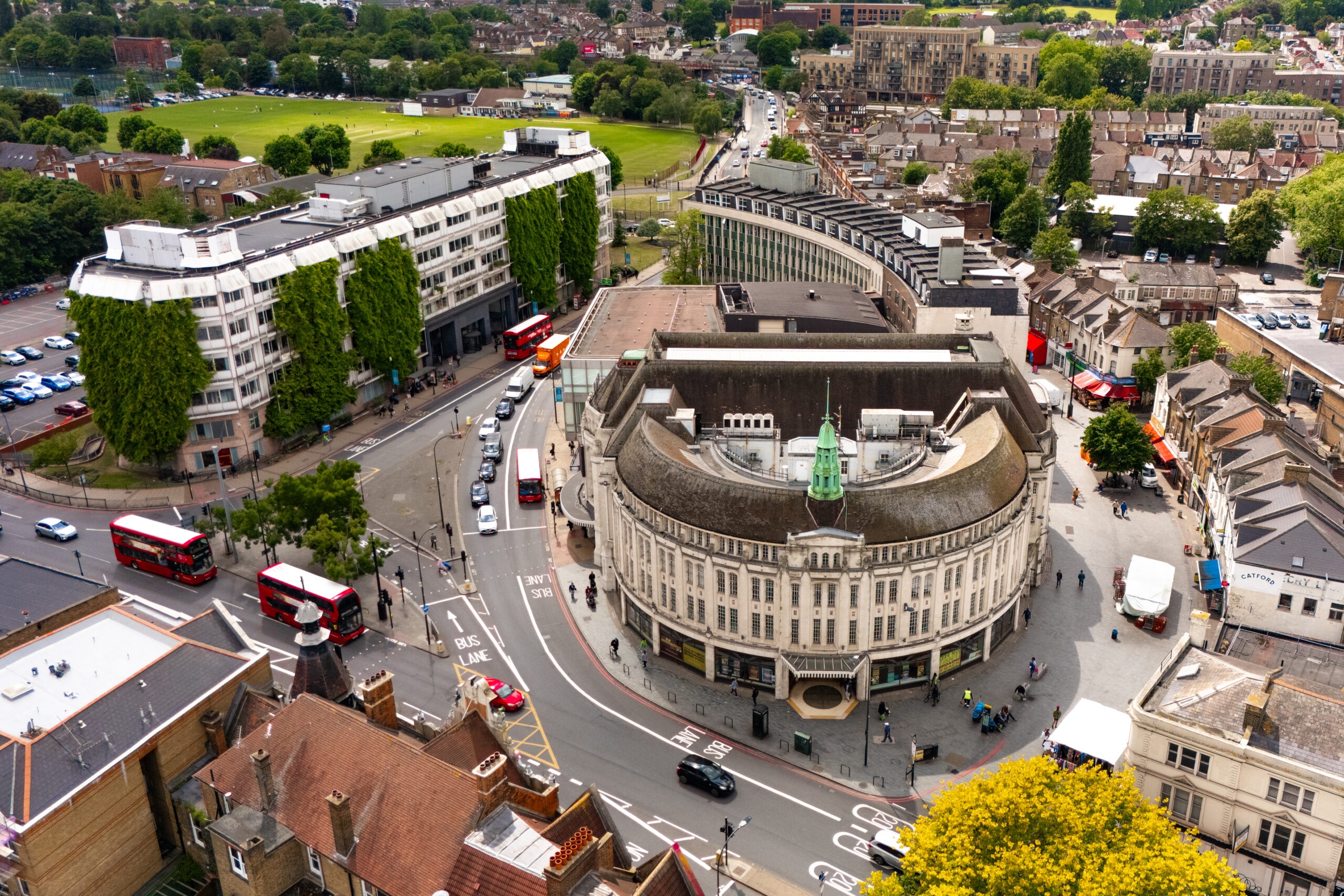
Catford buys you a whole house and a fast train for the price of a flat one stop north — affordability is the entire market story here. The overall median sold price is £460k (HM Land Registry), among the cheapest Zone 3 options in south-east London: below adjacent Hither Green and roughly level with Sydenham, but on cheaper terraced stock than either. It is a working town centre — a one-way gyratory carrying the South Circular, the dated 1970s shopping centre with its giant fibreglass cat — so the housing splits sharply between town-centre flats and the leafier terraced and semi-detached streets that ring it, including the sought-after Corbett estate. This is a house-led market where the terrace, not the flat, sets the tone, and a genuine value entry point for a buyer who wants a fast train to London Bridge without a Zone 2 price.
What Your Budget Buys
Flats run from £118k at the bottom to £785k at the top, with the typical flat around £330k — mostly town-centre blocks and period conversions.
Houses are the signature stock. Terraced homes span £240k to £1.15m, typically about £576k — a period terrace on a sought-after Corbett street sits well above the typical figure, a tired conversion candidate below it. Semi-detached houses run £270k to £1.31m, typically around £683k, on the leafier streets ringing the centre. Detached houses are scarce here, too few to quote a reliable figure — a rare find rather than a bracket to shop.
What Drives Values
Catford’s case is pure value and connectivity: a fast train to London Bridge from a Zone 3 price, whole houses where inner south-east London offers flats, and leafy terraced streets a short walk from the trains. What tempers it: the town centre itself is dated and dominated by the gyratory and the ageing shopping centre — long slated for redevelopment — so buyers pay for the streets that ring it rather than the core, and the appeal is the affordable house and the commute rather than the centre. The live median and by-type figures are in the cards above and on the price comparison page.
Leasehold vs Freehold
Catford’s flats — the town-centre blocks and the period conversions — are predominantly leasehold, so check the lease length and service-charge history before you offer. The terraced and semi-detached houses that make up the bulk of the market are almost all freehold.
Rental Yields (Buy-to-Let Context)
Catford is a higher-yield, affordable rental market with steady tenant demand. One-bed flats let for around £1,450 a month and two-beds for roughly £1,650–£1,800 (ONS Lewisham private-rent data cross-checked against Rightmove SE6 listings), putting gross yields around 5.0–6.4%, centring near 5.2–5.5% — strong for Zone 3. Tenant demand comes from commuters priced out of inner south-east London who want the fast London Bridge train, plus families after an affordable house with a garden. Voids are short for well-priced homes.
How Catford compares nearby
Median sold price, all property types, against the nearest comparable areas we cover.
HM Land Registry · prices last updated 5 August 2026
Schools in Catford
🏫 Primary
🏛 Secondary
Downderry Primary School
Holy Cross Catholic Primary School
Rathfern Primary School
Athelney Primary School
Elfrida Primary School
Good Shepherd RC School
Haberdashers' Knights Primary
Haseltine Primary School
Holbeach Primary School
Launcelot Primary School and Nursery
Rangefield Primary School
Rushey Green Primary School
St Augustine's Catholic Primary School and Nursery
St John Baptist Southend Church of England Primary School
Torridon Primary School
Bonus Pastor Catholic College
Haberdashers' Knights Academy
Sedgehill Academy
Data: Ofsted, 2 September 2026
School Overview
Catford has 18 schools, all rated Good or Outstanding by Ofsted — a solid primary picture paired with a genuinely thin state-secondary choice, and the honest read separates the two phases sharply. That count covers all phases across the wider catchment; the Outstanding ratings span both primary and secondary, though several rest on pre-2024 inspections. The strength is breadth at primary level; the weakness, covered below, is that secondary-age families have little to choose from inside Catford itself.
Primary Schools
The two Outstanding primaries anchor the offer. Holy Cross Catholic Primary (Culverley Road, SE6 2) is rated Outstanding (Ofsted, May 2023), a Roman Catholic voluntary-aided school whose places go first to baptised Catholic children. Rathfern Primary (Rathfern Road, SE6 4) was rated Outstanding at its last graded inspection (Ofsted, September 2021); it was re-inspected in January 2026 under the post-September-2024 framework, which no longer issues a single-word overall grade, so the 2021 Outstanding is the last headline rating on record. Beyond those, the Good primaries are spread across the area: Athelney (Ofsted, July 2022), Elfrida in Bellingham (Ofsted, June 2022), Holbeach (Ofsted, May 2023), Rushey Green (Ofsted, November 2022), Sandhurst (Ofsted, June 2024), St Augustine’s Catholic (Ofsted, March 2024) and Torridon (Ofsted, February 2023). Since September 2024 Ofsted has stopped issuing single-word overall grades, so for any school inspected after that date, verify the current position at reports.ofsted.gov.uk before relying on a rating.
Secondary Schools
Here is where Catford thins out, and it is the honest weak point of the area for families. The main local state secondary is Sedgehill Academy (Sedgehill Road), rated Good (Ofsted, September 2022). It posted a Progress 8 of +0.2 — but that figure belongs to 2022/23, and its 2023/24 attainment fell, so the headline understates a downward trend [DATA NEEDED: confirm the official Department for Education 2023/24 Progress 8 figure at compare-school-performance.service.gov.uk before relying on +0.2 as current]. Beyond Sedgehill, there is no broad state-secondary choice inside Catford itself, which is the single biggest reason secondary-age families either look to neighbouring areas across Lewisham or weigh the independent route.
Catchment Reality
The catchment reality follows the phase split. At primary level, the two Catholic schools — Holy Cross and St Augustine’s — admit on faith criteria first, so baptised Catholic children with parish references take priority and non-Catholic families face long odds at both; they run at or over capacity. Sedgehill Academy is reported as heavily oversubscribed at secondary level, so a Catford address is no guarantee of a place even at the one main local state secondary [DATA NEEDED: precise last-offer distances for the oversubscribed Catford primaries and for Sedgehill — pull from Lewisham Council’s published admission arrangements for the relevant year]. The practical advice is straightforward: if you are buying for a specific primary, confirm that year’s actual offer distance with Lewisham Council before you commit to a street, and if you have a secondary-age child, do not assume Catford alone solves the problem.
Independent Options
The independent option in Catford is St Dunstan’s College, a long-established and well-regarded private school. It is inspected by the Independent Schools Inspectorate rather than Ofsted (latest inspection April 2024, standards met) and posts an A-level average point score of around 46.9 — roughly an A-minus average (St Dunstan’s College, 2025 results). For families who can fund it, St Dunstan’s is the practical answer to Catford’s thin state-secondary choice; for those who cannot, the neighbouring areas across Lewisham are the realistic alternative.
For a bigger town with wider school choice, see our Croydon guide.
Transport & Commute: Catford
Commute Times
Source: TfL Journey Planner, 2026. All times are station-to-station (boarding to alighting); add 5–10 minutes for walking to your nearest station and waiting.
For another rail-only SE town, see Bromley.
Rail and Tube
Transport is Catford’s lowest score, at 39, and the headline reason is blunt: there is no Underground. The network is National Rail only, from two stations sitting almost side by side in the centre. Catford Bridge is on the Mid-Kent line and the genuine strength — a direct train reaches London Bridge in 12 minutes (around 11–14 minutes on Southeastern services), and the same line runs direct to Charing Cross and Cannon Street via Lewisham. The second station, Catford, is on the Catford Loop (Thameslink), giving direct trains to Blackfriars and Victoria with a change. So the score and the reality pull in opposite directions: the times are genuinely good — London Bridge in 12 minutes, the City, Canary Wharf and the West End all under 30 — but the no-Tube setup, the rail-frequency reality and a town centre strangled by the gyratory hold the score down.
Bus Network
Local buses converge on the gyratory and the two stations, linking Catford to Lewisham, Bromley, Peckham and across the borough — the network does the orbital work that the radial rail lines leave. For getting around the immediate area and reaching the destinations the trains do not serve directly, the buses carry the load; for a fast trip into central London, Catford Bridge and the 12-minute London Bridge run are the quick option.
Commute Times
| Destination | Route | Station-to-station |
|---|---|---|
| London Bridge | Mid-Kent line direct from Catford Bridge | 12 min |
| Waterloo | Rail + change | 23 min |
| Bank | Rail + change | 28 min |
| Canary Wharf | Rail + change | 27 min |
| Victoria | Catford Loop + change | 29 min |
Station-to-station, TfL Journey Planner, 08:30 weekday (refreshed June 2026). Add the time to reach and board your station. London Bridge is the fast, direct run from Catford Bridge; the City, Canary Wharf and West End journeys need a change but still come in under 30 minutes.
Cycling and Walking
The town centre is compact and walkable — both stations, the shopping centre and the Broadway sit within a short walk of each other — but the gyratory and the South Circular make it an unpleasant place to cycle through, which is part of what the masterplan is trying to fix. Quieter cycling runs through the residential streets and the parks rather than the centre, and Ladywell Fields and the River Ravensbourne offer a green walking and cycling corridor north toward Lewisham. The terrain is gently rolling, with Blythe Hill Fields a notable climb for a view. The whole area sits within the Ultra Low Emission Zone (ULEZ), London-wide since August 2023, so a non-compliant vehicle is charged daily.
Driving and Parking
Catford gives quick access to the South Circular (A205) and the A21, which is a mixed blessing — convenient for driving out, but the reason the town centre traffic is what it is. The area sits within the ULEZ and well outside the Congestion Charge zone. Controlled Parking Zones cover the centre and the streets around both stations, including Zone K to the west and Zone OB, both operating weekday daytime controls, with Lewisham actively expanding CPZ coverage across Catford and the surrounding areas through 2024–25, so on-street parking near the stations is permit-controlled and tight; the residential streets beyond the zone boundaries are easier.
Transport Verdict
Catford suits commuters to London Bridge, the City and the West End who want a fast, cheap journey and will trade the Tube for it — the 12-minute London Bridge run is the standout, and the under-30 times to Bank, Canary Wharf and Waterloo are better than the 39 score suggests. The limitation is real and explains that score: there is no Underground, the central destinations need a change, and the gyratory makes the town centre a place to pass through rather than linger in. Anyone who needs the Tube on their doorstep, or a one-seat ride to Canary Wharf, should weigh the daily reality carefully.
Crime & Safety in Catford
Top Concern
Source: Metropolitan Police via data.police.uk · Population: ONS Census 2021 · Updated monthly
The Numbers
Catford’s recorded crime runs 22% above the London average on a severity-weighted basis (the latest 12-month period, data.police.uk) — the single measure that best captures how the area compares with the rest of the city — and it is what drives the Safety Score of 34/100, benchmarked against every London neighbourhood we cover. On a residential basis — visitor and footfall theft set aside — the rate is 151 per 1,000 residents, 17% above the London average. Both readings point the same way: this is an above-average, working town centre for crime, not a quiet low-crime pocket. The largest category is Violence and sexual offences at 29%, so the profile is violence-led rather than theft-led. The one genuinely encouraging note is direction of travel — recorded crime is Falling (-8.1%) over the past year.
What the Data Tells You
The honest read is that Catford is a middling-to-higher-crime town centre, not a low-crime area. A Safety Score of 34/100 and a residential rate 22% above the London average both place it in the upper-middle of the range — elevated, not extreme, and not a postcode to sell as calm. The largest category is Violence and sexual offences at 29%, so this is a violence-led profile rather than a theft-led one, concentrated around the busy town centre and the gyratory where the footfall, the transport and the night-time economy put people and opportunity together. This is not an area to describe as “safe”; it is a working town centre with quieter residential edges.
Street-Level Context
The split between the centre and the streets around it is the defining pattern. The violence that drives Catford’s top crime category concentrates in and around the town centre — the gyratory, the shopping centre and the stations — where the crowds and the transport hub sit. Move out to the residential quarters and the picture calms: the Corbett Estate to the north-east, with its uniform terraces, and Catford South to the south-east, the leafier semi-detached and terraced streets, are firmly suburban and quieter. The closer you buy to the centre, the more of the town-centre texture you take on; the further out toward Corbett or Catford South, the calmer the streets.
What Residents Say
Residents draw the same line the data does: the gyratory and the centre are busy and see the bulk of the trouble, while the residential streets are settled. The practical takeaway for a buyer is straightforward. If you are buying a flat in or near the centre, treat it as town-centre living — stay aware around the gyratory and the stations after dark, and use a D-lock for any bike left near a station. If you are buying a house out in Corbett or Catford South, the everyday experience is quiet outer-suburban, and the headline rate will feel remote from your street.
Unlock the Complete Catford Guide
You’ve seen the headline data. Get the full picture — detailed narratives, council costs, community character, and our editorial verdict.
- 🎓 In-depth school, transport & crime analysis
- 🏛 Council tax & parking costs
- 🏘 Community character & local vibe
- ⭐ Editorial verdict, value assessment & future outlook
- 📦 Moving practicalities
By unlocking, you’re happy for us to email you this guide plus the occasional helpful update from Property Around London. No spam — unsubscribe anytime.
Council Fees in Catford
Council Tax (Annual)
| Band C | Band D | Band E |
|---|---|---|
| £1,989 | £2,237 | £2,735 |
Parking
Source: London Borough of Lewisham, 2026
Council Tax Bands
Catford sits within the London Borough of Lewisham, where the Band D charge is £2,237 — among the higher council tax bills in this part of south-east London. Most Catford town-centre flats fall in Bands A–C and most family houses in Bands C–F, so the typical bill is moderate in cash terms even if Lewisham’s rate is on the higher side. Lewisham is a stable outer-inner London authority with an active regeneration programme, though the headline Catford masterplan has repeatedly slipped.
Local Authority Services
Lewisham collects general rubbish and recycling and runs the usual borough services. Garden-waste collection is a paid subscription at £100.63 a year for a 240-litre bin (London Borough of Lewisham, 2026/27), and bulky-waste collection is among the cheapest in London at £5 per item, with fridges and freezers at £25 (London Borough of Lewisham, 2026/27). Resident parking permits are emissions-based — priced across CO₂ bands, with the lowest-emission cars and electric vehicles cheapest, a surcharge for older diesels and free permits for Blue Badge holders (London Borough of Lewisham, 2026); permit prices rose by CPI from April 2026 [DATA NEEDED: exact per-band 2026/27 permit pounds, available only via the council’s live permit calculator].
Waste and Recycling
Lewisham provides kerbside recycling alongside general waste collection, with the £100.63-a-year garden-waste subscription and the £5-per-item bulky-waste service as the chargeable extras (London Borough of Lewisham, 2026/27). For a town-centre flat the garden-waste charge is rarely relevant; for a house out in the Corbett or Catford South streets with a garden, it is a small annual cost to factor in. The cheap bulky-waste rate is a genuine plus for anyone clearing a property on a move.
Libraries and Leisure
Catford Library relocated within the town centre in 2022, and the refurbished Broadway Theatre — an Art Deco landmark reopened in February 2023 — anchors the area’s cultural offer, with an independent cinema due to return to the town centre. For green space and leisure, Mountsfield Park (home of the People’s Day festival), Ladywell Fields along the River Ravensbourne, Blythe Hill Fields and Forster Memorial Park ring the area; these are covered in the verdict and FAQs below.
Catford Community Character
For a comparable community feel, see Walthamstow.
A Cat, a Gyratory and a Slow Reinvention
Come out of Catford Bridge or Catford station and the first thing you meet is the South Circular (A205), grinding through the middle of town in a way no amount of regeneration talk has yet fixed. Look up and there's the compensation: the giant fibreglass Catford Cat, paw raised over the entrance to the dated 1970s shopping centre, beloved enough that residents petitioned to save it. It sets the tone honestly — this is a working, mixed, affordable corner of south-east London, not a polished one.
Turn off the main road onto Catford Broadway and the volume drops. The pedestrianised stretch carries a small street market and a thickening row of independents, with the Art Deco Broadway Theatre anchoring one end. Mumsnet regulars are clear-eyed about the trade-off: Catford is “a bit rough and ready but there are fantastic residential clusters and great parks,” as one local put it. Walk five minutes into the Victorian streets and you find exactly that.
Where the Lights Stay On Past Nine
The evening here is small but real, and it has just been rebuilt. The Catford House — the community-run pub that opened in November 2025 inside the area's oldest building, a 1736 Georgian farmhouse on Catford Broadway — has taken over from the much-missed Constitutional Club on the same site, with six handpumps and Portobello ales. A short walk west, the Blythe Hill Tavern keeps a different flame: a Grade II-listed Victorian corner pub run by a Limerick man, with racehorse prints on the walls and live Irish music on Tuesdays.
Beyond those, and a night at the Broadway Theatre, the centre quietens early. For a bigger night out most residents head to Brockley, Honor Oak or Lewisham. That is the honest shape of Catford after dark: a couple of good pubs, a grand old theatre, and an early night otherwise.
The Regulars' Shortlist
The Catford House (Catford Broadway) — the town's newest old pub, run by a community agency inside its 1736 farmhouse. Six handpumps, a community kitchen for pop-up chefs, and the warmth the closed Constitutional Club used to provide.
Blythe Hill Tavern (Stondon Park) — a Grade II-listed Victorian on the Forest Hill edge, Limerick-run, with a three-room layout, 1920s panelling and racing on the screens. The Tuesday Irish session marks it as a regulars' pub.
Broadway Theatre (Catford Broadway) — the 1932 Art Deco theatre that puts on everything from gigs to the annual panto, once gloriously titled Dick Whittington and His Catford Cat. Locals use it for kids' shows as much as evenings out.
Bottle Bar and Shop (Catford Broadway) — a small family-run bar and bottle shop pouring its own house-bottled cocktails, the kind of independent the Broadway has slowly drawn in.
Mountsfield Park (off Stainton Road) — the high-ground park with views back over the city, home to Lewisham People's Day every July. It is where the area gathers when it gathers.
Kingfishers, People's Day and an Unofficial Bonfire
Spring. The wildflower meadows in the south field of Ladywell Fields green up along the re-naturalised River Ravensbourne, where kingfishers are a regular sight and moorhens nest by the water.
Summer. Mountsfield Park hosts Lewisham People's Day in July, the borough's longest-running free festival since 1985, pulling crowds of well over 25,000 across one Saturday.
Autumn. Bonfire Night brings a large, unofficial fireworks display to Mountsfield Park — unsanctioned but a fixture, the hilltop crowding for the view over Catford.
Winter. The Broadway Theatre's pantomime lights up Catford Broadway through December, the one stretch of the centre guaranteed to feel busy on a dark evening.
Source: Google Maps, OS Open Greenspace & editorial research, 2026

Affordable, well-connected SE London — London Bridge in 12 minutes — with a beloved giant cat and a town-centre regeneration long promised.
Catford is one of SE London’s more affordable town centres, and better connected than its reputation suggests. The average home sells for £460,000.
Catford scores 48/100 on the PAL Score — our weighted rating across six core criteria that define what makes a London neighbourhood work for buyers.
How We Score
Each criterion is normalised on a 0–100 scale across every London neighbourhood we cover, so a score describes how Catford compares with the rest of the city, not an absolute mark.
The Breakdown
| Criterion | Score (/100) | What it means |
|---|---|---|
| Property Price Affordability | 58 | The cheapest terraced houses of its local cluster and a 12-minute London Bridge train; affordability is the area’s clearest strength. |
| School Quality | 52 | Two Outstanding state primaries and a broad Good primary choice, but a genuinely thin state-secondary offer. |
| Safety | 34 | 22% above the London average on a residential basis (Safety Score 34/100); a violence-led town centre with quieter residential edges. |
| Green Space Access | 47 | Mountsfield Park, Ladywell Fields and Blythe Hill Fields ring the area, but the traffic-dominated centre pulls the score down. |
| Local Amenities | 40 | A dated shopping centre and a gyratory-choked centre, though the Broadway Theatre and a reviving independent scene point to real creative energy. |
| Transport Connectivity | 39 | Fast, direct trains to London Bridge with no Tube and a traffic-strangled centre; the times beat the score. |
Scores use the PAL 0–100 scale, z-score normalised across all London neighbourhoods and displayed as integers. See the PAL Score Architecture for methodology.
What This Means
Affordability (58/100) carries Catford — it is comfortably the area’s strongest dimension, reflecting the cheapest terraced houses of its local cluster and a fast London Bridge train at a Zone 3 price, and it is the single best reason a buyer looks here. Schools (52) sit mid-table on the strength of two Outstanding state primaries and a broad Good primary choice, held back by the thin state-secondary offer that pushes families toward neighbouring areas or the independent St Dunstan’s College. Safety (34) is middling-to-elevated rather than reassuring — 22% above the London average on a residential basis, with violence concentrated around the centre. The marks holding the area back are green space (47), amenities (40) and transport (39). Green space scores moderately because the parks ring the area rather than sit in it, and the traffic-dominated centre drags the figure down. Amenities (40) reflect the dated shopping centre and the gyratory, even as the Broadway Theatre and a clutch of new independents build a genuine scene. Transport (39) is the lowest — no Tube and a choked centre — though the 12-minute London Bridge run makes the real journeys better than the number. The resulting 48/100 is a Fair score that rewards the value-minded buyer using the affordability and the fast train, and warns off anyone who needs the Underground, a polished town centre, or who is banking on the regeneration arriving soon.
For a livelier inner-SE alternative, see our Brixton guide.
✗ May Not Suit
💰 Value Assessment
At an average of £460,000, Catford is one of the more affordable Zone 3 neighbourhoods in SE London — flats around £330,000 and terraces £575,500 (HM Land Registry). It undercuts pricier SE neighbours like Beckenham, sits just below adjacent Sydenham and above Hither Green, and has outpaced both immediate neighbours over recent years. The affordability score of 58/100 is the highest of Catford’s six — this is where the area earns its keep.
Our Recommendation
Who's Catford for?
Catford could be a strong fit if you:
- Want Zone 3 space at a keener price. The median home is £460,000 and flats start from £118k, with the typical flat around £330k — affordability is comfortably the area’s strongest score (58/100).
- Commute to the City or London Bridge. Catford Bridge runs direct to London Bridge in 12 minutes, with Charing Cross and Cannon Street on the same line.
- Have primary-age children. Two Outstanding state primaries — Holy Cross Catholic and Rathfern — sit among a deep bench of Good schools.
- Use parks and a real local scene. Mountsfield Park, Ladywell Fields and the Ravensbourne ring the area, and the Broadway Theatre and the Catford House anchor a genuine independent culture.
- Are happy backing an area mid-change. You buy in before a long-promised regeneration that may — or may not — reshape the centre.
Think twice if you:
- Want a low-crime postcode. Recorded crime runs 22% above the London average (Safety Score 34/100), violence-led and concentrated near the gyratory.
- Need a calm, walkable centre. The South Circular gyratory cuts through the heart of the town, and the 1970s shopping centre is dated and traffic-choked.
- Are counting on regeneration. Lewisham’s masterplan lost its road funding in 2025 and the centre’s redevelopment is deferred to the 2030s — buy for today, not the plan.
- Have a secondary-age child and want choice. State secondary options in Catford itself are thin; Sedgehill is the main one, and many families look beyond the area at 11.
- Need the Underground. There is no Tube; the network is National Rail and buses only.
The Real Picture
Catford is an honest bargain: a working, mixed, affordable south-east London town centre with a 12-minute train to London Bridge and leafy Victorian streets a few minutes from a traffic-heavy core. You accept a rough-edged centre, an above-average, violence-led crime profile and a regeneration that has been promised for years and may not arrive on schedule. For a buyer who values space, connectivity and price over polish — and who will use the parks and the trains rather than the shopping centre — it is a lot of London for the money. For someone wanting a finished, quiet, low-crime address, it is not there yet.
Moving to Catford: The Practical Side
Council Tax
Catford is in the London Borough of Lewisham.
The Band D charge is £2,237.
Parking
Controlled Parking Zones cover the town centre and the streets around both stations — Zone K to the west and Zone OB among them — and Lewisham has been expanding CPZ coverage across Catford and neighbouring areas through 2024–25, so check the specific zone for any address on the Lewisham parking map before assuming you can park on-street. Resident permits are emissions-based: lowest-emission cars and electric vehicles pay the least, older diesels carry a surcharge, and Blue Badge holders park free (London Borough of Lewisham, 2026). On-street parking is tight near the centre and the stations on weekdays and easier on the residential streets beyond the zone boundaries [DATA NEEDED: exact per-band 2026/27 resident permit pounds, available only via the council’s permit calculator].
GP Surgeries
Catford is served by practices including Parkview Surgery (Brownhill Road, SE6 1AT), South Lewisham Group Practice (Conisborough Crescent, SE6 2SP) and The Bellingham Green Surgery (Bellingham Green, SE6 3JB) — all rated Good by the Care Quality Commission (CQC ratings as displayed, June 2026; no central-Catford surgery currently holds an Outstanding rating, and South Lewisham Group Practice rests on the most recent inspection, December 2021). The nearest acute hospital with a 24-hour A&E is University Hospital Lewisham (Lewisham High Street, SE13 6LH), about a mile and a half away, run by Lewisham and Greenwich NHS Trust; its most recent CQC overall rating is Requires Improvement (report published January 2024), so check current ratings if hospital quality matters to you.
Utilities and Broadband
Broadband is well served. Lewisham borough is about 92% gigabit-capable and 81% full-fibre (thinkbroadband, June 2026), above the UK averages of around 87% gigabit and 78% full fibre (Ofcom Connected Nations 2025), with Virgin Media cable, Openreach full fibre and the Community Fibre alt-net all competing across the area. A precise SE6-only full-fibre figure is not published — the borough figures are the best proxy [DATA NEEDED: standalone FTTP percentage for SE6]. Energy costs track the Ofgem outer-London regional average; the older Corbett and Bellingham stock will have weaker energy ratings than the newer Catford Green flats, so check the EPC before you buy.
Removals and Access
The town-centre flats sit within Controlled Parking Zones with weekday daytime controls, so a removals van may need a permit or dispensation from Lewisham — arrange it in advance. The gyratory and the South Circular make midday access to the central streets slow, so an early or off-peak slot helps. The Victorian terraces of the Corbett Estate and the Edwardian streets of Culverley Green sit on quieter residential roads with easier access, though the older terraces have narrower frontages. Road access via the South Circular and the A21 gives removals firms a straightforward route in.
Frequently Asked Questions
Common questions about living in Catford, answered with data from our research.
The median terraced house in Catford sold for £575,500 over the past year (HM Land Registry, to June 2026) — a midpoint, with terraces ranging from about £240k to £1.15m either side of it — while the overall median across all property types is £460,000. That makes Catford the cheapest of its local cluster on terraced stock — roughly £220,000 below neighbouring Hither Green’s £796,000 average terrace and roughly £155,000 below Sydenham’s. The median flat is £330,000 (flats run from around £118k to £785k), among the most affordable Zone 3 options in south-east London. Affordability is Catford’s main draw, and the area has grown a touch faster than its neighbours lately, up 5.6% over five years.
About 12 minutes to London Bridge on a direct Mid-Kent line train from Catford Bridge — the fast, headline link, and Catford’s strongest transport feature. The same line runs direct to Charing Cross and Cannon Street via Lewisham. The City (Bank around 28 minutes), Canary Wharf (27) and the West End (Waterloo 23) all come in under 30 minutes but need a change. These are station-to-station times (TfL, 08:30 weekday); add your walk to the station. There is no Underground, so the central destinations beyond London Bridge involve a change.
The primary picture is solid, the secondary one thin. There are 18 schools within reach, including 4 rated Outstanding by Ofsted — Holy Cross Catholic Primary (Outstanding, Ofsted May 2023) and Rathfern Primary (Outstanding at its last graded inspection, September 2021). A broad set of Good primaries surrounds them. The weakness is at secondary level: the main local state secondary, Sedgehill Academy (Good, Ofsted September 2022), is the realistic state option inside Catford, so secondary-age families often look to neighbouring areas or to the independent St Dunstan’s College.
Catford is middling-to-higher for crime by London standards, not low-crime. Its residential crime rate is 151 over the latest 12-month period (data.police.uk), which works out 22% above the London average on a harm-weighted basis and gives the area a Safety Score of 34/100, benchmarked against all of London. The largest category is Violence and sexual offences at 29%, concentrated around the busy town centre and the gyratory; the residential streets out toward the Corbett Estate and Catford South are notably quieter. The one bright spot is the trend — recorded crime is Falling (-8.1%) over the past year.
Council tax is set by the London Borough of Lewisham, with a Band D charge of £2,237 — among the higher bills in this part of south-east London. Most town-centre flats fall in Bands A–C and most family houses in Bands C–F, so the typical bill is moderate in cash terms even though Lewisham’s rate sits on the higher side. Lewisham charges £100.63 a year for garden-waste collection and an unusually cheap £5 per item for bulky waste, worth knowing for a house with a garden or a move to clear.
It depends what you want. Catford is the cheapest of the three on terraced houses — its median terrace is about £220,000 below Hither Green’s and roughly £155,000 below Sydenham’s (HM Land Registry, to June 2026) — and it has grown a touch faster, up 5.6% over five years against Hither Green’s 1.1% and Sydenham’s −0.7%. Hither Green is quieter and more residential with a gentler station; Sydenham has more of a high-street scene. Catford is the value and fast-commute play, with a busier, more traffic-dominated town centre as the trade-off.
No — Catford has no Underground station. Its two National Rail stations sit side by side in the centre: Catford Bridge, on the Mid-Kent line, runs direct to London Bridge in 12 minutes and on to Charing Cross and Cannon Street; Catford, on the Catford Loop, reaches Blackfriars and Victoria with a change. For Canary Wharf and the deep City you will need a change, so the area suits London Bridge, City-fringe and West End commuters who value a fast, cheap journey over a one-seat Tube ride.
Big plans, repeatedly delayed. Lewisham’s Catford Town Centre Framework (approved 2021) sets out up to 2,700 new homes over about two decades, hinged on shifting the South Circular and removing the gyratory to pedestrianise the centre. That road scheme reached a compulsory purchase order in January 2024, but in July 2025 the Department for Transport pulled its expected funding route, and the project sits in hiatus in mid-2026 with no confirmed start (TfL; From the Murky Depths, 2025). The shopping-centre redevelopment is now deferred to the mid-2030s at the earliest. Delivered schemes — Catford Green (588 homes, around 2019) and the refurbished Broadway Theatre — sit at the edges. Treat the masterplan as possible upside, not a plan to price in.
For rental income it is one of the stronger affordable options. One- and two-bed flats let for roughly £1,450–£1,800 a month (ONS Lewisham and Rightmove SE6, 2026), and set against flat values around £330,000 that gives gross yields of about 5.0–6.4%, ahead of pricier neighbours. Tenant demand comes from commuters wanting the 12-minute London Bridge run at a Catford rent, and borough rents were rising faster than London as a whole in early 2026. The caveat is location within Catford: a flat in the quieter Corbett or Culverley Green streets lets faster than a generic conversion in the gyratory’s orbit.
For houses, the leafier residential quarters are the draw: the late-Victorian Corbett Estate to the north-east, toward Hither Green, with its uniform terraces and no-pubs history, and the semi-detached streets of Catford South to the south-east. The Edwardian villas of the Culverley Green Conservation Area, east of Bromley Road, are the most protected period stock. These streets are quieter than the centre and further from the gyratory’s traffic and noise. Closer in, you trade calm for a shorter walk to the two stations and the Broadway’s cinema and theatre.
Data from HM Land Registry, Ofsted, Metropolitan Police & TfL. Page last regenerated 31 August 2026.
Moving to Catford?
Get our free moving checklist and local tips delivered to your inbox.
No spam. Unsubscribe anytime.